Last updated:
The cheapest water upgrade in your home probably costs less than a pizza and is a simple swap you can do yourself. It is the small mesh screen screwed into the tip of your faucet, and it quietly decides how many gallons slip down your drain every single day. Most people never think about it, which is exactly why it is worth five minutes of your attention.
What a Faucet Aerator Actually Is
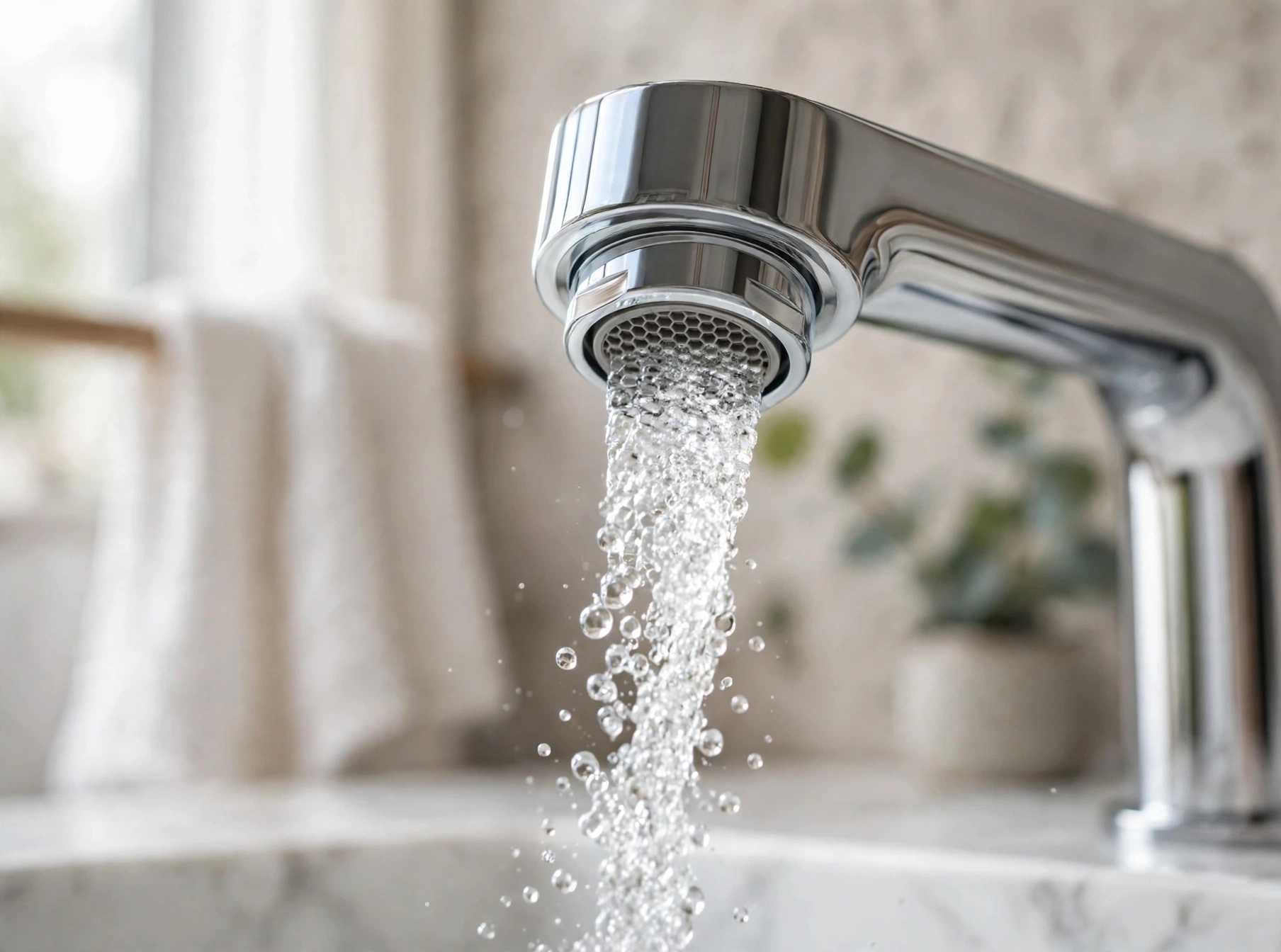
A faucet aerator is a small fitting that screws onto the end of your faucet spout. Inside its little housing you will usually find a mesh screen, a flow restrictor, and a mixer that pulls air into the water. That is the whole device. It has one job: control how much water leaves your faucet and shape the stream that comes out.
Nearly every modern faucet ships with one already installed, which means many homes are already using an aerator without realizing it. The catch is that older or builder grade aerators often flow at 2.2 gallons per minute, the maximum the law allows, while newer
efficient ones use far less. Swapping the small screen is one of the simplest ways to cut a home’s water use without changing how you live.

How an Aerator Shapes the Stream
An aerator does two things at once. First, its restrictor caps the volume of water passing through, which is what the GPM rating describes. Second, it mixes air into that smaller volume of water, so the stream still looks and feels full when it hits your hands.
This matters because an aerator limits flow, not static pressure. Your home’s water pressure stays whatever it is; the aerator simply decides how much of it becomes actual water coming out of the spout. A good low flow aerator feels surprisingly normal because the airy stream covers your hands the same way, even though fewer gallons are moving.
What GPM Means at Your Faucet
GPM stands for gallons per minute, and it is simply a measure of how much water flows out of the faucet in one minute. A 2.2 GPM aerator lets 2.2 gallons through each minute; a 1.5 GPM aerator lets 1.5 gallons through. The difference, 0.7 gallons every minute, is water you never miss because the stream still does its job.
One detail worth knowing: flow ratings are measured at 60 psi of water pressure. Your home’s actual pressure may be higher or lower, so the real flow at your sink can differ a bit from the number on the package. The U.S. EPA’s WaterSense program accounts for this by requiring labeled bathroom aerators to still deliver at least 0.8 GPM when pressure drops to 20 psi, so a labeled model keeps working even in low pressure homes.
Bathroom Faucets: Rules and WaterSense Eligibility
Bathroom and lavatory faucets are where aerators shine brightest, and they are also where the rules are clearest. Faucet aerators for bathroom sinks are eligible for the EPA WaterSense label, which makes shopping simple: look for the label and you know the product meets the current specification.
The current WaterSense specification for bathroom faucet aerators sets a maximum of 1.5 GPM at 60 psi, with that minimum performance flow of 0.8 GPM at 20 psi described above. You may hear talk of a draft version 2.0 specification proposing a 1.2 GPM maximum. That draft is paused and not in effect, so do not shop as if it were the current rule. Buy to the labeled specification that exists today.
Kitchen Faucets: Rules Without a WaterSense Label
Kitchens play by different rules. The federal legal maximum for kitchen faucets is 2.2 GPM at 60 psi, the same ceiling as older bathroom faucets. That is the law, and it is worth saying plainly because a lot of efficient looking advice blurs this line.
What the EPA currently recommends is a different number: EPA currently lists 1.8 GPM or less as its recommended efficiency criterion for kitchen faucets. That is guidance for choosing an efficient model, not a legal requirement. EPA’s guidance for efficient homes points to a range of 1.5 to 1.8 GPM, and the Department of Energy’s Federal Energy Management Program suggests considering 1.5 GPM to maximize savings.
One more distinction that trips people up: kitchen faucets are not eligible for the WaterSense label at all. Work on a WaterSense specification for kitchen faucets is paused, so you will not find a labeled kitchen aerator the way you can for the bathroom. For the kitchen, shop by the GPM number and the EPA recommendation, not by a label.
Which GPM Should You Choose? A Simple Decision Framework
Here is the whole decision in one table. Find your faucet, pick your row, and you are done.
| Faucet | Choose | Why |
|---|---|---|
| Bathroom sink, the safe default | 1.5 GPM with the WaterSense label | Meets the current specification; labeled models are widely available and proven |
| Bathroom sink, deeper savings | 1.0 GPM WaterSense labeled model, if available | Uses a third less than 1.5 GPM; fine for handwashing and brushing, but filling a basin takes noticeably longer |
| Kitchen sink, balanced | 1.8 GPM | Matches the EPA’s current recommended efficiency criterion |
| Kitchen sink, maximum savings | 1.5 GPM | Follows the energy management guidance to maximize savings; filling big pots takes longer, so weigh that against your cooking habits |
One caution: a lower GPM number alone does not prove WaterSense qualification. The label means the product passed the full WaterSense performance requirements, so look for the actual label rather than shopping by the number alone.
A practical way to think about it: the bathroom is the easy win because handwashing barely notices the difference between 1.5 and 2.2 GPM. The kitchen deserves a moment of honest thought about how you actually use the sink. If you fill large pots every night, 1.8 GPM may suit you better than 1.5. If your kitchen use is mostly rinsing and quick washes, 1.5 GPM is a fine choice.
Why Very Low Flow Aerators Stay in Public Restrooms
You will sometimes see 0.5 GPM aerators for sale, and it is tempting to think lower is always better. It is not, at least not for a home. Those 0.5 GPM models exist for public lavatories, where plumbing codes and federal guidance set very low flows for restrooms used briefly by many people.
For a residential bathroom or kitchen, 0.5 GPM is not the target. At home you wash faces, fill kettles, rinse dishes, and do all the small tasks that turn painfully slow at half a gallon per minute. Stick with the residential choices in the framework above and leave the 0.5 GPM models to airports and office buildings.
Sizing: Matching Threads to Your Faucet
Aerators are not one size fits all, but sizing is less scary than it looks. The threads that screw into your faucet come in a handful of standard sizes. Common U.S. aerator thread sizes include: 15/16 inch 27 male threads, 55/64 inch 27 female threads, 13/16 inch 27 junior male threads, 3/4 inch 27 junior female threads, and the smaller M19 and M20 variants. These sizes are manufacturer verified, but they are common sizes, not universal ones, so treat them as a starting point rather than a guarantee.

Male threads sit on the outside of the aerator and screw into the faucet; female threads sit on the inside and screw onto it. Many aerators sold today are dual thread, meaning they include an adapter so one product fits either style.
Before you buy, do one quick check: unscrew your existing aerator and look at it. Many have the size stamped right on the side. If yours does not, measure the opening or check your faucet’s manual or the manufacturer’s specifications. Taking the old aerator to the store, or ordering only after confirming your measurements, saves you the classic mistake of buying the wrong thread and discovering it on a Sunday evening.
Installation Checklist
Swapping a standard aerator is usually a simple DIY task. Work through this list in order:

- Keep the faucet off. You are working at the spout tip, downstream of the valves, so there is no need to shut off water to the house.
- Try unscrewing the old aerator by hand first, turning counterclockwise. Many come off easily.
- If it is stuck, grip it with pliers through a folded cloth or rag so you do not scratch the finish, then turn.
- Once it is off, note the washer inside and whether the threads were male or female. Rinse any grit out of the faucet spout threads.
- Check that the washer or gasket is present and seated flat. Most aerators seal with this washer, so get that right first. Use thread seal tape only if your faucet or aerator manufacturer specifically instructs it.
- Screw the new aerator on by hand until snug. If it needs a final snug, use the cloth and pliers gently. Do not overtighten; hand tight plus a nudge is enough.
- Turn the faucet on and check the joint for drips. If it weeps, first check the alignment, the washer seating, and that the threads match, then snug it gently. Do not just crank it tighter.
If your faucet has a hidden or cache aerator, recessed up inside the spout, it unscrews with the matching removal key. The key may be supplied with the faucet or replacement aerator, or it may need to be purchased separately. The steps are otherwise the same.
The Honest Math: What an Aerator Can Save
Here is the transparent calculation, step by step, so you can check every number. These are illustrative figures based on stated assumptions, not promised savings.
Start with a bathroom faucet running at the old standard of 2.2 GPM, and replace its aerator with a 1.5 GPM WaterSense model. The difference is 0.7 gallons saved every minute the faucet runs.
Now assume that faucet runs about 5 minutes per day across handwashing, brushing, and face washing. That is a guess, and yours may differ, which is exactly why the assumption is stated.
0.7 gallons per minute multiplied by 5 minutes per day equals 3.5 gallons per day. Multiplied by 365 days, that comes to about 1,278 gallons per year for that one faucet.
The same arithmetic works for the kitchen:
| Swap | Saved per minute | Assumed daily run time | Estimated yearly savings |
|---|---|---|---|
| Bathroom: 2.2 to 1.5 GPM | 0.7 gal | 5 min | about 1,278 gal |
| Kitchen: 2.2 to 1.8 GPM | 0.4 gal | 8 min | about 1,168 gal |
| Kitchen: 2.2 to 1.5 GPM | 0.7 gal | 8 min | about 2,044 gal |
Two faucets at the bathroom rate would roughly double the bathroom figure. A busy family kitchen that runs longer than 8 minutes a day would land higher. The math is simple on purpose: every extra minute of run time and every extra faucet multiplies the result.
What These Numbers Assume
Honest math needs honest boundaries, so here they are. The flow ratings assume measurement at 60 psi; if your home pressure is much higher or lower, your real savings shift with it. The daily run times are reasonable guesses, not measurements of your household. The figures are per faucet, so count your sinks. And none of this accounts for behavior: turning the tap off while you brush or scrub already saves water with any aerator, and leaving it running wastes water with any aerator. The aerator trims the flow; your habits decide how many minutes that flow runs.
Cleaning and Troubleshooting
Aerators do clog over time, especially in areas with hard water or older pipes. If flow drops at a single faucet, inspect and clean the aerator according to the manufacturer’s instructions; sediment or mineral buildup can restrict flow.
In practice that usually means unscrewing the aerator, tapping out the trapped grit, rinsing the little screen, and screwing it back on. A soft brush helps with stubborn buildup. There is no universal cleaning schedule worth following; let the flow tell you when it is time.
One diagnostic trick is worth keeping in your pocket. A clogged aerator is a common easy-to-check cause of reduced flow at a single faucet, so if one sink goes weak while the rest of the house runs fine, the aerator is the first place to look. If several or all fixtures lose flow at the same time, the cause is more likely upstream rather than a single aerator, such as a valve, pressure regulator, filter, well system, supply issue, or another plumbing restriction. An aerator swap will not fix that.
Frequently Asked Questions
Will a low flow aerator make my water pressure feel weak?
Your water pressure itself does not change, because an aerator limits flow rather than pressure. Aeration can make the smaller volume of water feel fuller against your hands, and the difference may be less noticeable during common bathroom tasks like handwashing. That said, user experience can vary.
Can I install a 0.5 GPM aerator in my home bathroom to save even more?
It is not recommended. The 0.5 GPM models are intended for public lavatories under plumbing codes, not for residential use. At home, everyday tasks like filling a basin or rinsing become frustratingly slow. For a house, 1.5 GPM or 1.0 GPM in the bathroom is the sensible range.
Are there WaterSense labeled aerators for kitchen faucets?
No. Kitchen faucets are not eligible for the WaterSense label, and development of a kitchen specification is paused. For the kitchen, choose by GPM instead: the EPA currently recommends 1.8 GPM or less, with 1.5 GPM as the deeper savings option.
How do I know which size aerator fits my faucet?
Unscrew the old one and look for a stamped size on its side; that is the fastest answer. Otherwise measure the threads or check your faucet manual or manufacturer specifications. Common U.S. aerator thread sizes include 15/16 inch 27 male, 55/64 inch 27 female, 13/16 inch 27 junior sizes, 3/4 inch 27 junior female, and M19/M20 variants. Confirm your measurements before buying.
How much water will an aerator really save me?
It depends on your starting flow, your faucet habits, and how many sinks you upgrade. The worked examples above show the method: a bathroom swap from 2.2 to 1.5 GPM at an assumed 5 minutes of daily use comes to about 1,278 gallons a year for one faucet. Run your own numbers with your own run time and treat the result as an illustration, not a guarantee.
The Bottom Line
A faucet aerator is the smallest serious water upgrade a home can make. For the bathroom, choose a 1.5 GPM WaterSense labeled aerator. For many standard faucets, replacing an aerator is a simple, quick retrofit. For the kitchen, pick 1.8 or 1.5 GPM against the EPA’s current recommendation and your own cooking habits. Match the threads, screw it on, and let the honest math do the rest. If you are mapping your home’s bigger water picture first, our home water audit guide is the natural place to start. Extend the same fixture check to the shower with low-flow showerheads, choosing by GPM just as you did at the sink.