Last updated:
A sustainable home renovation starts with the home you already have: what is failing, what works, and what could stay. Planning eco-friendly home renovations does not mean buying every efficient appliance or replacing sound finishes. Repairing, retaining or postponing work may be the more useful decision.
This guide helps you turn those choices into a written scope, a coordinated sequence and a way to check the result. Put safety, moisture control and durability ahead of efficiency purchases. Technical requirements and permissions vary by location; the program and labeling examples below are U.S.-focused.
GreenerPulse’s contribution is researched editorial synthesis and practical planning tools. The examples are hypothetical, not measured renovation projects or professional design advice.
Start With Your Home, Your Goals and Your Permission to Change It
Define the Problem and the Outcome You Need
Write a problem before naming a product: “The bedroom is uncomfortable on winter evenings” is more useful than “Buy new windows.” Note when it happens, what you have observed and what a satisfactory result would look like. Separate a repair need from a preference for a different appearance.
Choose a Small Upgrade, a Staged Retrofit or a Major Renovation
A small project addresses a defined issue without opening multiple parts of the building. A staged retrofit spreads coordinated improvements across time. A major renovation may create access for several trades but also brings more disruption and decisions. Match the scope to your resources; for modest changes, see our sustainable home upgrades under $200.
What Renters and Owners Need to Confirm First
Renters should document defects, contact the property manager and obtain permission before altering fixtures or building fabric. Start with permitted, reversible changes. Owners should check permit requirements, shared-building responsibilities, association restrictions and any heritage constraints. Record who can authorize work and who will maintain it.
Step 1: Decide What to Keep, Repair, Replace or Defer
Inspect Existing Features Before Planning Demolition
Make an inventory of the affected rooms, systems and finishes. Record condition, known repairs and compatibility with the proposed work. Ask whether the problem can be corrected without removing the whole item. A cosmetic defect and a failing assembly need different responses.
Keep sound components that meet the need; repair when a suitable repair addresses the cause; replace when condition or compatibility justifies it; defer when the evidence or need is insufficient. Safety can override this preference for retention.
Use the Keep, Repair, Replace or Defer Decision Table
These are hypothetical prompts, not diagnoses or universal replacement rules. Confirm the evidence before selecting a decision.
On a narrow screen, scroll within each wide table to see all columns.
| Existing item | Actual problem | Repair option | Dependency / compatibility | Evidence needed | Provisional decision |
|---|---|---|---|---|---|
| Drafty but sound window | Air movement near the sash | Adjust hardware or renew suitable seals | Drainage, ventilation and surrounding wall condition | Identify the leakage path; check operation and water entry | Repair if the assembly is sound; reassess afterward |
| Worn cabinet fronts | Finish damage; storage still works | Refinish or replace fronts only | Sound boxes, compatible hinges and planned layout | Condition check, coating suitability and repair quote | Keep boxes if suitable; compare front repairs |
| Leaking toilet | Water continues entering the bowl | Diagnose and replace the failed part | Compatible parts; inspect for other damage | Leak diagnosis, flush rating and repair estimate | Repair when practical; compare replacement if needed |
| Failing HVAC system | Cannot reliably provide needed heating or cooling | Qualified fault diagnosis and repair assessment | Planned envelope work, distribution and electrical capacity | Diagnosis, load calculation and installed alternatives | Replace if justified; coordinate urgent work with the wider plan |
| Roof approaching replacement | Condition requires investigation | Assess whether localized repair is sufficient | Future solar, flashing, insulation and roof access | Roof inspection and written scope | Resolve roof work before committing to rooftop equipment |
Step 2: Check Condition, Safety and Current Resource Use
Resolve Moisture, Structural and Hazardous-Material Questions
Persistent damp, active leaks, mold, rot or structural movement are reasons to investigate before covering surfaces or adding insulation. Use an appropriately qualified professional for diagnosis and repair planning. Efficiency work should not conceal an unresolved building problem.
Before disturbing painted surfaces in a U.S. home built before 1978, account for possible lead paint and consult EPA’s lead-safe renovation guidance. Suspected asbestos or vermiculite insulation is a stop-point for disturbance, not a DIY identification exercise. ENERGY STAR’s attic project precautions also identify moisture, wiring and combustion-related conditions that warrant professional help.
Gather Energy, Fuel, Water and Comfort Baselines
Collect a full seasonal cycle of bills if available, keeping electricity, gas and other fuels separate. Record water consumption, billing periods, occupancy changes and comfort complaints. Note visible leaks, fixture flow or flush ratings, HVAC condition and any known insulation gaps. Mark unknowns instead of guessing. Bills establish a baseline; they do not predict the savings from a proposed project.
Choose the Right Assessment and Ask for Specific Deliverables
A homeowner walkthrough can organize observations. A professional energy assessment can investigate their causes; diagnostic tests are specific services that must be included in the scope. Ask which tests are proposed, why they are useful, what they cost and what written findings you will receive.
DOE’s assessment guide explains blower-door testing and infrared scans. Thermal images show temperature patterns requiring interpretation; they do not independently prove every air leak. Request priorities, safety findings, dependencies and the assumptions behind any savings estimate.
A Home Energy Score is not automatically a comprehensive diagnostic audit. Its technical documentation allows infiltration inputs without a measured blower-door result. Confirm what the assessor will actually inspect and test.

Step 3: Put Projects in a Sensible Order
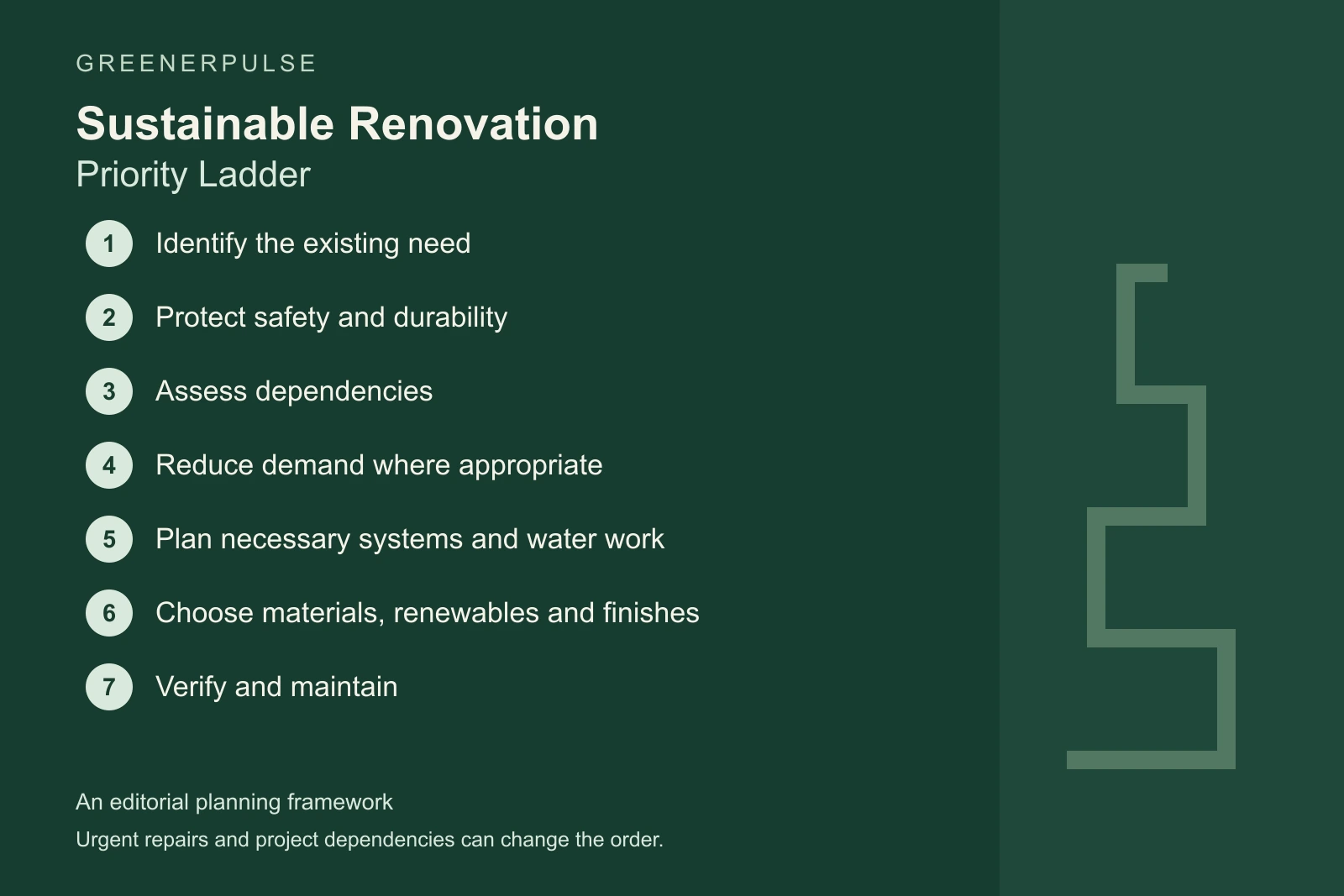
GreenerPulse Sustainable Renovation Priority Ladder
This is an editorial planning framework, not a scientific rating, carbon score or universal construction sequence. Use it to ask the next question:
- Identify the existing need. Define the problem and what can remain.
- Protect safety and durability. Resolve hazards, leaks and deterioration.
- Assess dependencies. Confirm permissions, evidence and access requirements.
- Reduce demand where appropriate. Consider suitable envelope improvements and avoidable energy use.
- Plan necessary systems and water work. Coordinate equipment, distribution, ventilation and leak repairs.
- Choose materials, renewables and finishes. Verify suitability and evidence within the agreed scope.
- Verify and maintain. Test the work, collect records and review performance.
An emergency HVAC failure, urgent roof repair, active plumbing failure or electrical safety issue may need immediate action. Work needed before another trade closes access also changes the order. The ladder is a decision aid, not a reason to delay necessary repairs.
Reduce Loads and Coordinate Ventilation Before Sizing Equipment
Tell the designer which envelope improvements are actually planned so equipment calculations represent the intended home. Coordinate ventilation and combustion safety with substantial airtightness changes. Do not choose a universal air-change target or simply replace equipment with the same size.
Plan Work That Must Happen Before Walls, Roofs or Floors Close
Have trades agree on routes and access for wiring, plumbing, ventilation, insulation and air sealing. Identify structural work, roof penetrations and electrical provisions early. Put required inspection and testing before concealment in the written sequence, including who confirms it is safe to close an area.
Step 4: Compare Energy, Water and Equipment Options
Air Sealing, Insulation, Window Repair and Shading
Choose measures suited to the climate and the actual wall, roof or floor assembly. Resolve moisture first, then compare targeted sealing, insulation, window repairs and useful shading. A sound window may need adjustment or seals rather than replacement. Ask for the reason behind any proposed replacement.
Keep combustion appliances, flues, wiring and moisture risks within the professional assessment. Airtightness, ventilation and insulation need coordinated design; no single insulation material is the default answer for every home.
Heating, Cooling, Hot Water and Electrical Readiness
Start with the existing system’s condition and repair options. For a heat pump, request climate-appropriate equipment selection, heating and cooling load calculations, distribution checks and a commissioning plan. PNNL’s cold-climate sizing guidance explains why envelope inputs and existing air distribution matter.
Have the relevant trades assess electrical capacity, controls and any needed enabling work. For hot water, compare household demand, available space, installation requirements and maintenance access. Include these costs in the quote; an equipment price alone is not an installed project price.
Fix Leaks and Check Fixture Flow Before Buying Replacements
Investigate leaks first. Record the existing fixture’s rating and actual use before estimating a benefit. In the U.S., WaterSense bathroom faucets and accessories have a maximum flow of 1.5 gallons per minute; that scope does not extend to kitchen faucets. Showerheads and residential toilets have separate specifications. Verify the exact product’s label and compatibility.
Household savings depend on the fixture replaced and how it is used. Reducing hot-water use can also affect water-heating demand. Treat greywater reuse as a separate, locally regulated project: EPA’s reuse research addresses treatment and health protection. Do not assume untreated sink or shower water is suitable for garden distribution.
Maintain, Repair or Replace Appliances and Lighting
Compare repairability, condition, use and the efficiency difference before replacing a working appliance. Read model-specific energy information and include installation or connection changes. For lighting, compare brightness in lumens, power in watts, color and fixture or dimmer compatibility.
Do not require an ENERGY STAR logo on every new bulb: the U.S. Lamps and Luminaires specifications were discontinued at the end of 2024, while downlights have a separate specification. Check the current lighting program information.
Check Roof Readiness and Local Economics Before Solar
Before ordering rooftop solar, have the roof condition, shading, electrical capacity and connection requirements assessed. Model future electricity demand after planned equipment changes. Compare local tariffs, export compensation, ownership terms and maintenance responsibilities. Coordinate roof work first where needed, and verify current incentives before including them in the budget.
Step 5: Choose Materials and Plan for Less Waste
Reuse Suitable Materials and Design for Durability and Repair
Start with what can safely remain. For new or reused materials, compare fitness for the location, expected maintenance, replaceable parts and access for future repairs. Reclaimed material needs condition and contamination checks; it is not automatically the lowest-carbon option. Transport, preparation and suitability still matter.
Decode Forestry, Emissions and Environmental Claims
Ask for evidence tied to the exact product and intended use. “Natural” is not a safety or performance certification. This decoder identifies questions to ask, not products endorsed by GreenerPulse.
| Advertised claim | What to verify | Evidence to request | What it does not prove |
|---|---|---|---|
| FSC | Exact product and whether the label is 100%, Mix or Recycled | Applicable label, license information and supplier documentation | Formaldehyde-free adhesive or every environmental property |
| Low / zero VOC | Whether the claim concerns content or tested emissions; tint and use conditions | Product data, safety data and relevant emissions report | Harmlessness or absence of all potentially concerning emissions |
| GREENGUARD | Current certification, exact model and certification level | Product listing and chemical-emissions certification | Every health, durability or environmental property |
| Recycled content | Percentage, pre- or post-consumer basis and which component it covers | Product-specific content declaration or verification | Recyclability locally or lower total impact |
| Reclaimed | Origin, condition, treatments and suitability | Supplier history, inspection and any necessary testing | Automatic safety or the lowest carbon footprint |
| Local | What location or distance the seller means | Manufacturing and supply-route information | Lower cost or carbon without a relevant comparison |
| Low embodied carbon | Comparison product, equivalent function and life-cycle boundaries | Comparable life-cycle results and assumptions | Lower impact under every installation or service-life scenario |
| Environmental Product Declaration (EPD) | Product coverage, validity, calculation rules, units and included life-cycle stages | Full verified declaration and applicable Product Category Rules | Environmental superiority simply because a declaration exists |
| Biodegradable | Which material, conditions, time and actual disposal route are covered | Relevant test evidence and facility acceptance | Safe home composting or decomposition in landfill |
| Durable / repairable | Suitability for exposure, replaceable parts and service access | Warranty terms, maintenance instructions and parts availability | A guaranteed service life in every home |
| Cradle to Cradle Certified | Exact product, certification scope, level, version and validity | Current certificate; distinguish Full Scope from Material Health certification | That a narrower certificate covers all five Full Scope categories |
| Declare | Current label and its Red List status | Product label and disclosed exceptions or status | That “Declared,” “Red List Approved” and “Red List Free” mean the same thing |
For broad terms such as recycled, degradable or recyclable, the FTC’s environmental-claims guidance helps explain why qualifications matter. Replace a vague green claim in your specification with the property and evidence you actually need.
Confirm Salvage, Recycling and Safe Disposal Before Demolition
Plan in this order: avoid unnecessary work, retain suitable items, arrange salvage or reuse, confirm accepted recycling streams, then arrange appropriate disposal. EPA’s construction-material guidance supports prevention and reuse before managing waste.
Contact receiving organizations before removal. Confirm condition requirements, separation, storage, transport and who pays. Keep hazardous materials out of ordinary salvage streams and use the required local handling route. Receipts document destinations; they do not make a project “zero waste” or automatically certified.
Step 6: Build the Budget and Brief the Right Professionals
Compare Complete Written Scopes and Local Installed Quotes
Give bidders the same problem statement and scope. Request assessment or design, permits, preparation, materials, equipment, labor, disposal, testing, commissioning and finishing as identifiable items. Record exclusions, quote validity, payment milestones and responsibility for unexpected conditions.
Set a reserve appropriate to the unresolved risks and your ability to absorb them. There is no useful universal split between materials, labor and contingency. Clarify what happens if opening a wall reveals damage before authorizing that stage.
Separate Necessary Costs, Efficiency Benefits and Uncertain Savings
When something already needs replacement, distinguish the full project cost from the additional cost of a more efficient suitable option. Compare alternatives that deliver the required service. Ask whether projected savings include changed fuels, maintenance and tariffs.
A simple payback calculation divides net eligible incremental cost by a justified estimate of annual net savings. It does not capture every financing, maintenance, service-life or comfort consideration. If credible inputs are missing, write “not estimated.” Necessary safety work does not need a fabricated payback to justify it.
Verify Incentives and Approvals Before Committing
U.S. program check — October 2, 2026: The IRS says Section 25C is unavailable for property placed in service after December 31, 2025, and Section 25D is unavailable for expenditures made after that date. Do not budget the former heat-pump or residential solar credits as offers for new 2026 work. See the IRS termination FAQs; claiming eligible earlier work is a different question.
Other assistance depends on where you live and the current program. Start with DOE’s home energy rebates information, then check the official state, territorial, Tribal or utility administrator. Confirm funding status, household eligibility, qualifying products, installer requirements, preapproval, deadlines and whether benefits can be combined. Keep dated confirmation; a directory listing or contractor promise is not an award.
Check Relevant Experience, Credentials and Commissioning Plans
Check the appropriate license where required, insurance, similar-project experience, references, written scope and warranties. Ask who will design, install, test and correct problems. Confirm required program participation separately.
Credentials answer different questions: BPI credentials have distinct assessment or installation scopes; DOE Energy Skilled recognizes training and certification programs; LEED AP concerns green-building and rating-system knowledge. None substitutes for checking the person’s relevant authorization, experience and proposed work. They do not guarantee workmanship, incentives or project success.
Step 7: Schedule Dependencies and Verify the Finished Work
Set Approval, Delivery, Inspection and Testing Milestones
Build the schedule around dependencies: approvals, ordering, enabling work, installation, inspection and testing, concealment and finishes, commissioning, then closeout. Some activities overlap or repeat. Ask each trade what must be complete before arrival and what another trade will need afterward.
Allow for actual permit processes, lead times, access and household disruption. Agree on responsibility for delays and change orders. There is no universal week count or percentage of spare time that fits every renovation.
Commission Systems and Collect Closeout Records
Define acceptance evidence before work starts. Depending on scope, it might include inspection approval, leak checks, ventilation measurements or equipment commissioning records. Ask for a demonstration of controls and maintenance access.
Keep permits, invoices, model numbers, warranties, manuals, test results, commissioning records and any supplied as-built information together. Record maintenance requirements from the actual equipment instructions rather than applying a generic filter or service schedule to everything.
Compare Performance Without Confusing Weather or Fuel Changes
Review comfort and resource use against the original problem. Compare similar periods and account for weather, occupancy, tariff changes, fuel switching, added equipment and thermostat settings. Electricity use may rise when it replaces another fuel; a bill alone cannot isolate the renovation’s effect.
Optional monitors can help investigate a defined question, but buying one does not guarantee savings. Persistent problems deserve diagnosis against equipment specifications and commissioning results, not a universal runtime alarm.
Complete Your Sustainable Renovation Planning Worksheet
Copy this template into your own project notes and complete one version for each proposed project. “Unknown — investigate” is a useful answer. The example column is one partial hypothetical window-repair plan; blank decisions require evidence, not invented prices or savings.
| Field | Your planning prompt | Partial hypothetical example |
|---|---|---|
| Problem to solve | Describe the symptom and needed outcome | Draft near bedroom window; improve comfort |
| Baseline | Observations, use records, photos or measurements | Draft noticed on windy evenings; cause unconfirmed |
| Owner / renter permission | Who must approve? | Owner; check local requirements |
| Priority reason | Safety, durability, comfort or resource use? | Comfort; investigate any water entry first |
| Proposed scope | Define work and its limits | Inspect sash, hardware, seals and surrounding assembly |
| What can remain | List suitable retained items | Window and trim if inspection confirms suitability |
| Dependencies | What must happen first? | Condition check before choosing repair |
| Responsible professional | Name and agreed role | To be selected |
| Quote / date | Installed scope, price and validity | Not obtained |
| Exclusions | What is outside the quote? | To be confirmed |
| Reserve | Amount and risks it covers | Not set |
| Incentive verified? | Official source, date and conditions | None assumed |
| Approval before purchase? | Permit, owner or program approval | To be checked |
| Disruption | Access, dust, noise and room use | Bedroom access; agree protection and cleanup |
| Milestone | Dependency and responsible person | Review inspection findings before ordering |
| Acceptance evidence | How will the result be checked? | Agreed repair checks, operation and comfort review |
| Maintenance record | Instructions and service notes | Collect instructions for installed parts |
| Deferred work | What is postponed and when to reconsider? | Full replacement pending repair assessment |
Common Planning Questions
What should I do first with a limited renovation budget?
Address urgent hazards or damage, then pay for the information needed to avoid an unsuitable purchase. Choose one defined problem and compare repair with replacement before expanding the scope.
Is keeping an existing material better than buying a green replacement?
It can avoid new purchases and waste when the material remains safe and fit for purpose. Condition, exposure and the work needed to retain it still matter; a label alone cannot settle the comparison.
Should I replace windows before improving insulation?
There is no universal order. Identify the cause of discomfort and assess the window, surrounding assembly and insulation together. Urgent water entry needs attention even if another measure offers more energy benefit.
Can I plan a sustainable renovation in stages?
Yes. Keep a shared plan showing future equipment assumptions, access requirements and work that must precede concealment. Revisit it when the scope or household needs change.
Does a sustainable renovation need green-building certification?
Formal certification is optional unless a particular agreement or program requires it. If you want it, confirm the chosen scheme’s applicability, costs and documentation before design; collecting waste receipts alone is insufficient.
How do I check which renovation incentives are currently available?
Use the official administrator for your location and proposed work. Verify eligibility and any approval needed before purchase. Save the dated rules and confirmation rather than relying on an old article or sales estimate.
Choose Your Next Step
Write down the real problem, what can stay and the evidence still missing. Use the worksheet to identify dependencies and the right professional input. Then choose the next justified project, with a clear way to check its result.